The Graduate Record Examination is not very difficult. Really!
.jpg)
Privatising public sector companies would have encountered significant opposition from their managers as well as from strong unions.

'In contrast to the generally buoyant tone of the Economic Survey in January, he sounds uncharacteristically pessimistic, saying that forces in the world economy -- slowing global trade, protectionism, robots -- will limit India's manufacturing to levels well below what propelled East Asia's economies decades ago.'

Jaitley's team presents a quintessential mix of foreign-educated, intellectual technocrats and seasoned bureaucrats
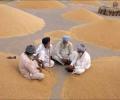
India is threatening to block the World Trade Organization (WTO)'s trade facilitation agreement (TFA) reached at Bali last year unless its agricultural policies are permanently excluded from multilateral scrutiny.

After helping the government in policymaking since October 2014, Chief Economic Adviser Arvind Subramanian is returning to academics and will be teaching at Harvard Kennedy School on a visiting position. In an interview to Dilasha Seth and Somesh Jha, he says the ease of doing business agenda needs to move forward and India must try to integrate with the global value chains. Edited excerpts.

The Tata empire turns 150 this year. R Gopalakrishnan, former director, Tata Sons Ltd, imagines a conversation among the group's founder Jamsetji, his son Dorabji, his successor, Nowroji Saklatwala, and his successor, J R D Tata.
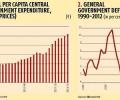
One may fault this government for incompetence, corruption, and delayed action but it cannot be faulted for lacking a vision.

'India is no longer the India of the '70s and the '80s.' 'It's a large country with the fastest growing economy.' 'In working with India, you just can't go and humiliate the nation publicly.' USIBC President Mukesh Aghi tells Aziz Haniffa/Rediff.com about how he advises American companies to do business with India, what he thinks of Modi's government and the way forward for the India-US relationship.
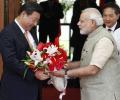
Arvind Subramanian talks about US and China's power play and where India figures in these dynamics.
